Hot water takes too long to reach the bathroom, and your morning stalls.
A few careful notes can help Salt Lake City homeowners separate a familiar delivery delay from a new hot-water problem.
Compare the pattern before changing equipment.
Note whether hot water eventually arrives and stays warm, whether nearby taps behave differently, and whether the delay has recently changed.
Record notes during normal use. Do not raise the heater setting or leave taps running repeatedly to force a faster result.
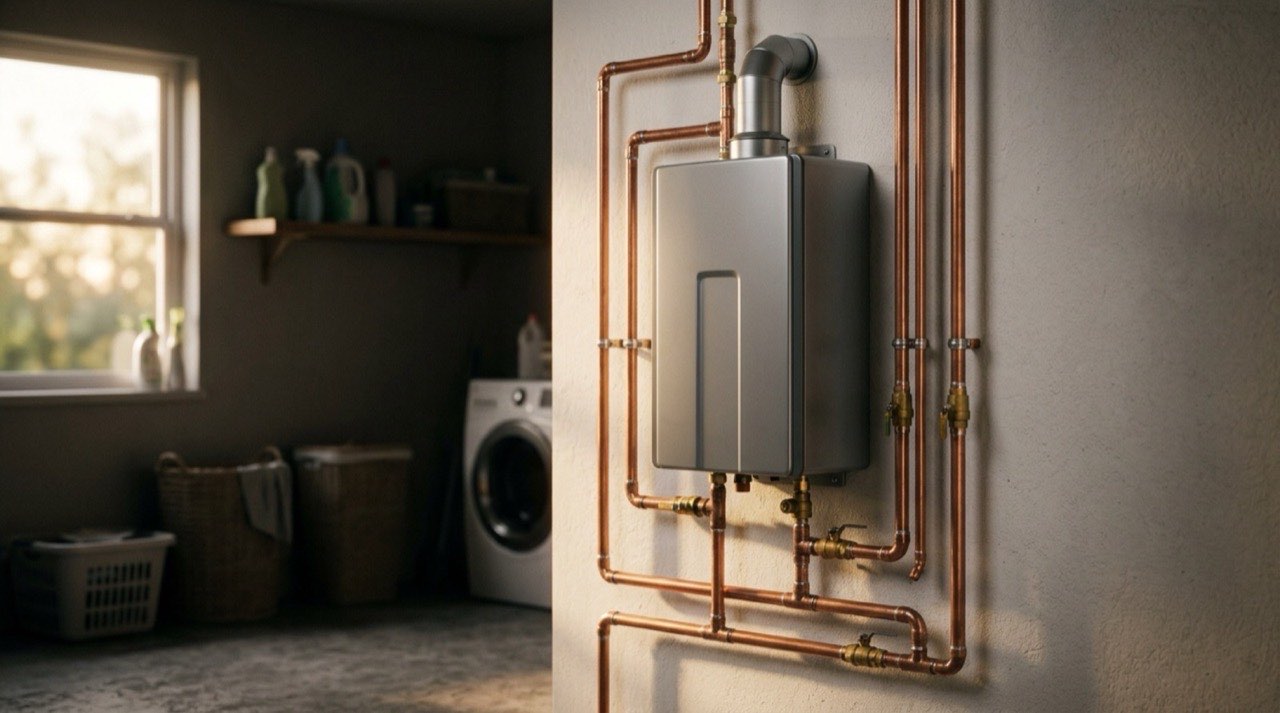
Separate waiting from losing hot water
Start with one clear description of what happens. “The bathroom starts cold, then becomes warm and stays warm” describes delayed arrival.
“It warms up, then turns cold while running” describes a different pattern. “It never becomes warm” is different again.
These notes do not prove the cause. They do keep the service call focused.
A long wait alone does not show that the heater has stopped working.
A familiar wait followed by a sudden loss of heat deserves a different check.
The EPA's hot-water delivery guidance explains that plumbing distribution design affects how quickly hot water reaches a fixture.
Water stored in the piping between the heat source and the outlet is part of that delivery question.
The route inside a wall may not follow the shortest distance across a room.
A bathroom that looks close to the heater is not proof of a short pipe run.
Leave hidden-pipe routing to a check rather than guessing from the floor plan.
Compare ordinary use at two fixtures
Choose the distant fixture and a second tap that normally gets hot water sooner.
Observe them during separate, ordinary uses rather than running both as a prolonged test.
Keep the handles at familiar settings and avoid scalding water.
Write down which fixture you used, whether the water had been unused for a while, and whether another appliance was drawing hot water.
A clock can help record the wait, but there is no single normal time that applies to every home.
If you cannot safely tell when the water warms, skip the comparison.
This is a record for a plumber, not a reason to handle hot water or alter a fixture.
A caregiver can describe a problem without asking a child or vulnerable person to test it.
For an ongoing delay, contact Valley Plumbing for water heater service. Describe what changed and ask for a check.
Mention that delivery to the bathroom is the concern.
Notice what changed recently
A delay that has always been there differs from one that began yesterday. Make that clear in your notes.
Record when you first noticed the change, even if the date is approximate.
Useful context includes a replaced faucet, a changed household routine, recent plumbing work, or an existing circulation control that now shows a different setting.
Report those changes without assuming any one caused the problem.
If a circulation system is already installed, find its visible model label and manual.
Do not change wiring, timers, or valves merely because an online guide describes another system.
Tell the plumber whether its display changed or stopped showing the usual status.
If several taps now fail to warm, include that in the service call.
A whole-house change should not be hidden behind a description of the most annoying bathroom.
Conversely, one slow outlet does not justify declaring every part of the hot-water system faulty.
Use a comparison that answers a question
Imagine a hypothetical home where the distant sink has always taken longer on the first morning use.
The kitchen still behaves as usual, and the bathroom water remains warm once it arrives.
That record gives the plumber a focused delivery question.
Now change one detail: the same bathroom used to warm promptly, but it became much slower after a fixture replacement.
That recent change matters. Both homes have slow hot water, but their stories differ.
The comparison is useful because it preserves what is different.
Avoid adding guessed pipe sizes, assumed heater capacity, or a diagnosis copied from a video.
Those details can steer the discussion away from the observed problem.
Discuss changes after the cause is checked
The EPA describes distribution layouts and demand-initiated recirculation as ways to improve delivery.
That does not mean every existing home needs a pump, or that adding one will resolve every delay.
Ask what part of the system explains the wait, what a proposed change would affect, and whether the existing heater or fixtures limit the options.
Do not assume replacing the heater changes the amount of water waiting in a distant pipe.
Keep safety problems separate from inconvenience.
If you also find a leak, unusually hot water, or water near electrical equipment, stop routine comparisons and ask for prompt guidance about that condition.
Bring a clear pattern to the service call
For hot water that takes too long in your Salt Lake City home, contact Valley Plumbing for water heater service.
Share the affected fixtures, what changed, and whether the water stays warm after it arrives.
Those details help frame the next step without choosing a replacement before the problem is understood.